
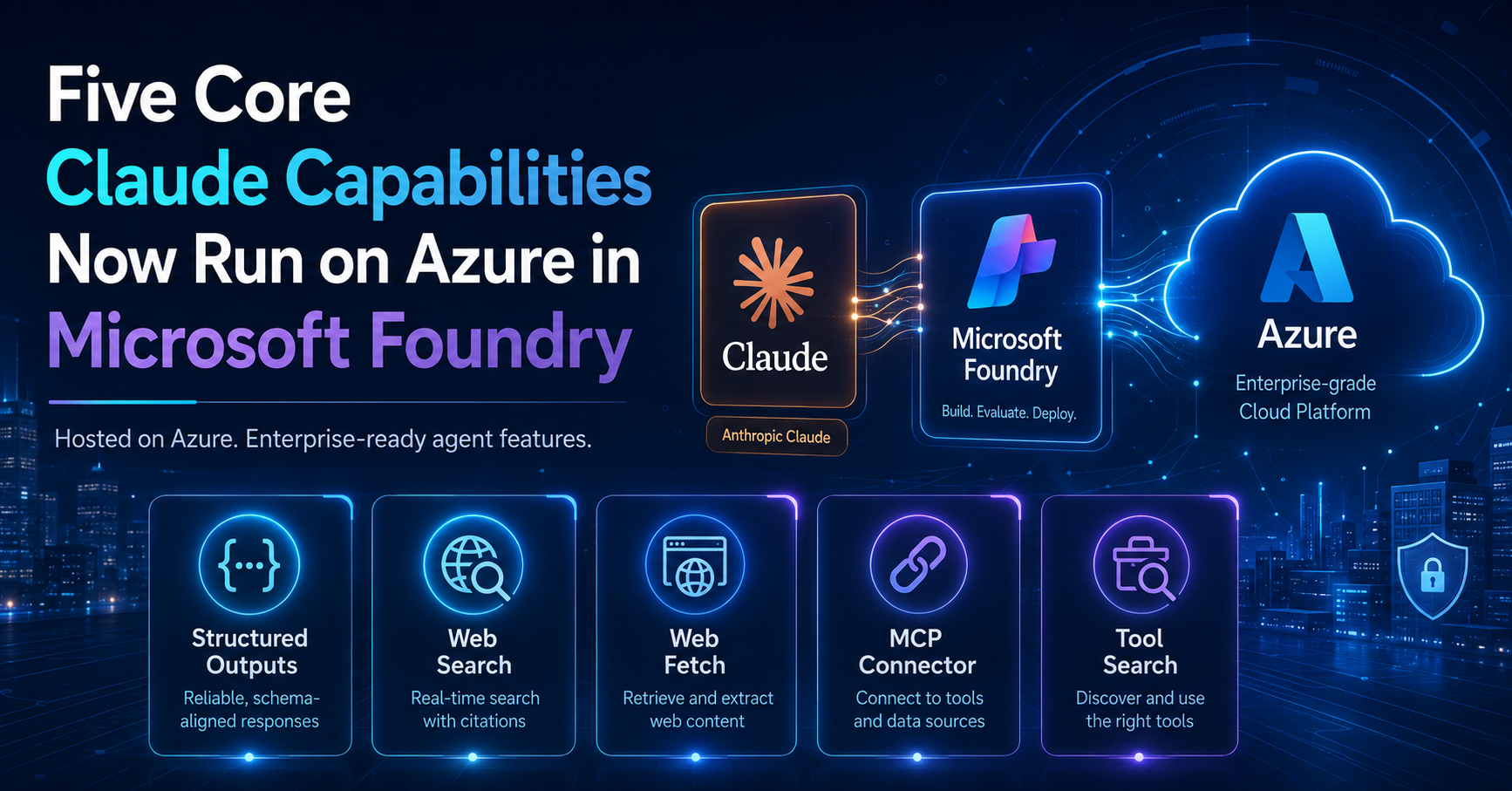
When evaluating Claude in Microsoft Foundry, start with two questions: which hosting option fits your data requirements, and which capabilities are available for that deployment?
This overview covers five capabilities worth evaluating and the application responsibilities that remain.
Documentation reviewed September 6, 2026: The written notes below reflect Microsoft’s current capability and data-handling documentation. The video is the original August 2026 discussion; this is not a new deployment test.

Check the Hosting Option First
Microsoft Foundry offers Claude hosted on Azure and Claude hosted on Anthropic infrastructure. Anthropic is the seller and operator in both cases and acts as an independent data processor.
For the Azure-hosted option, request ingress, API services, and inference run on Azure. Storage geography and processing scope depend on the deployment option. Safety-flagged content can be reviewed by Anthropic. External tools introduce their own destinations and data flows.
Review the Microsoft data-handling documentation against your actual workload rather than treating the hosting label as a blanket compliance guarantee.
Five Capabilities to Evaluate
Structured outputs: Constrain responses or tool inputs to a JSON schema. This helps with format validation; it does not prove business correctness or remove the need to handle failures and retries.
Web search: Retrieve information from the web. Review sources and choose restrictions appropriate to the task.
Web fetch: Read a selected page or document. Check the tool’s supported formats and citation options.
MCP connectivity: Connect to remote tools. Verify authentication, tool permissions, and feature availability for your model and hosting option.
Tool search: Discover relevant tools without loading every definition up front. Measure token use and selection quality with your own tool set; there is no universal savings percentage.
Availability and parameters vary. Check the current Microsoft Claude capability tables.
What Your Application Still Owns
Define permissions, review consequential actions, handle errors, and test representative workflows. A successful response is only useful if the downstream system can trust and operate on it.
Continue with the AI agents and MCP learning path or the Azure integration lessons.